Family12 min readEditorial illustration scenario
Page of Swords and a Binh Duong Meal: When Silence Stops Being a Family Bridge
At 31, Khoa delayed telling his father the truth about An and the pregnancy. Four cards did not write a winning script — they showed how to open mouth and ear.
Reader
Air Element Reader ·
Back
ContextMust have a hard talk with his father about marriage and staying in Saigon
Khoa held his phone for ten minutes without tapping Call. His father's name sat on the screen — three simple characters, heavy as an unfinished Tet conversation. Thirty-one years old, a QA engineer at a software company in Thu Duc, he texted dutiful check-ins every weekend and avoided the real sentences. His father still ran a small electronics-parts shop in Binh Duong; every call ended with the same question: "When are you coming home to help me?" This time was different. His partner, An, was eight weeks pregnant. They wanted to stay in Saigon, marry on their own terms, and tell the truth before rumor outran explanation. Khoa was not afraid of his father shouting. He was afraid of the silence afterward — the family kind of silence that replaces argument. A friend introduced him to Air Element Reader. Khoa arrived with a prepared question: "How do I speak so Dad won't get angry?" Sitting down, he revised it because it sounded like asking for a winning script. The new question: "What do I need to say — and what do I need to hear — in the conversation with my father?" Air Element Reader looked at him for a moment. "We'll use a communication-bridge spread — four cards. Tarot will not write your dialogue. It will show how you're opening your mouth and how you're closing your ears." The small café near Thu Duc market still smelled of phin coffee. Khoa put both hands on the table; his palms were damp. Outside, someone hailed a motorbike taxi. He thought: if I don't speak this week, I'll postpone again until Tet — and Tet in our house is not where truth gets said. Khoa was an only son. His mother died when he was a second-year university student; after that his father was both parent and shopkeeper. Khoa felt gratitude. He also knew he did not want to stand behind a parts counter all day, even though the shop had fed his education. After graduating he stayed in Saigon and sent money home on schedule. His father accepted the money, rarely praised him, and often asked when he would return. An taught primary school, came from the Mekong Delta, spoke slowly, smiled easily. The first time Khoa brought her to Binh Duong, his father was polite and cold: questions about her job, her salary, her family's house, then a line to Khoa — "Think carefully." An cried on the ride back — not because she had been scolded, but because she felt like a variable waiting to be optimized. Khoa promised to speak clearly with his father. Then he delayed four months by sending fruit, tonic drinks, everything except the truth. They argued for the first time over that delay. An did not demand he choose her over his father. She only said, "You're letting silence decide for us." He knew she was right. He had rehearsed the talk in his head: open with gratitude, middle with income figures, close with promises to visit often. Every draft sounded like a leave request, not a conversation between two people. The week they learned An was pregnant, Khoa bought two bowls of hu tieu near their apartment and could not finish them. He feared his father would think he had been "forced." He feared An would think he was ashamed. Most of all he feared opening his mouth and softening every sentence until nobody understood what he was choosing. One night he drafted a long message and deleted it, because every version began with "Dad, please don't be angry" — an opening that put his father in the defendant's chair before the story even started. An sat beside him, not reading the draft, only asking, "Are you protecting your dad, protecting me, or protecting the image of a son who never disappoints him?" Khoa could not answer immediately. That was why he came to Air Element Reader — not to hear "just say it and it will be fine," but to see which tools he was bringing to the table: a sharp sword, a balancing cup, or the fear of losing love.
First card: Page of Swords upright, Present. A young figure holding a sword, wind in the hair, eyes alert. Air Element Reader said, "You're in the posture of someone learning to speak truth — curious, wary, a little rushed. Page of Swords upright helps when you use the blade to ask and clarify, not to stab first." Khoa nodded. He admitted he had thought "being direct" meant dumping everything in one breath without letting his father interrupt — like release notes, not dialogue.
Second card: Temperance upright, Support. An angel pouring water between cups, one foot on land, one in water. "This is pacing," Air Element Reader said. "Not forcing everything into a ten-minute call. Temperance upright **because** this topic needs the right mix: truth + respect + time to settle." Khoa remembered calls where his father listened while watching the shop; if he dumped the pregnancy news in the first sentence, his father would only have a defensive reflex left.
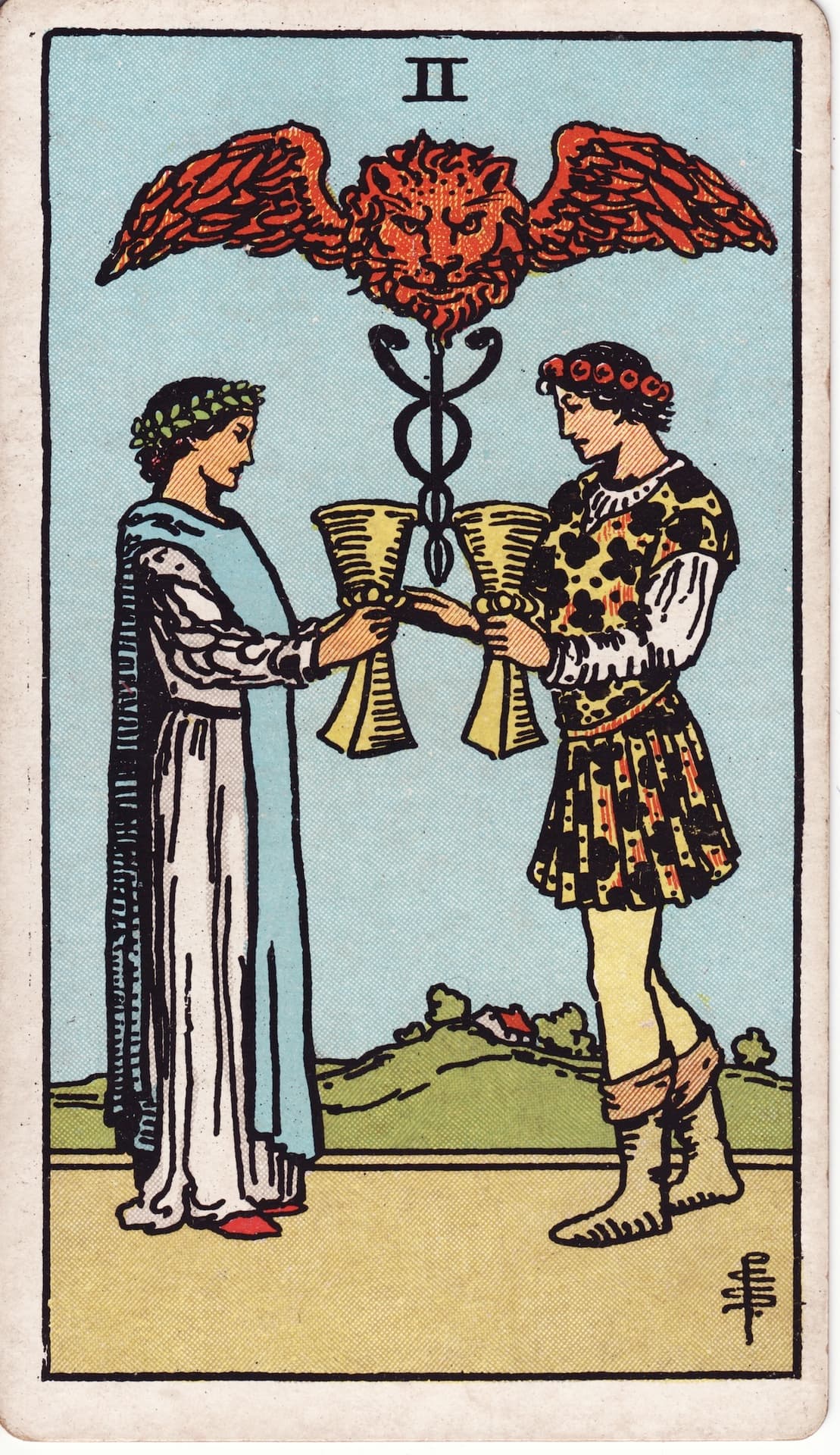
Third card: Two of Cups reversed, Challenge. The cups no longer meet in balance. Khoa swallowed. Air Element Reader did not read for the father. She spoke about Khoa: "Two of Cups reversed here is a bond out of rhythm — not necessarily the end of love. You're holding the image of 'good son' and the image of 'soon-to-be father' like two cups that refuse to pour into each other." He understood: the challenge was not "will Dad accept this," but whether he dared let the father-son relationship update with reality **but** without pretending he was still twenty.
Fourth card: The Sun upright, Outcome. A child on a horse, light with nowhere to hide. Air Element Reader smiled: "The Sun does not promise your father will be happy immediately. It promises daylight — speak clearly, live clearly, fewer self-made shadows. The Sun upright **when** you stop using silence as a roof." Khoa exhaled. He had wanted Outcome to be his father hugging An in joyful tears. The four cards offered something else: a conversation bright enough that both sides knew where they stood. Air Element Reader linked the cards: Page of Swords opens **because** fruit deliveries cannot replace truth forever; Temperance holds the pace **but** is not another four-month delay; Two of Cups reversed names the misalignment **when** he looks straight at it; The Sun appears **if** he lets truth into daylight instead of editing it until it loses meaning. Khoa asked, "What if he hangs up?" Air Element Reader answered, "Then you will have spoken. A bridge is not always crossed at once — but without a bridge, no one can cross." She added that Page of Swords often wants to win on logic; Temperance asks him to leave room for his father's fear about aging alone behind a shop counter — not to surrender his life plan, but to hear the fear without treating it as a courtroom exhibit. "Communication is two-way," Air Element Reader reminded him. "You've been preparing a monologue. Page of Swords wants to speak; Temperance wants to listen; Two of Cups reversed wants the hurt named; The Sun wants the performance to end." Khoa wrote three things he needed to say: (1) he loved An and they would marry; (2) he would not return to run the shop full-time, and would keep visiting and supporting financially as he already had; (3) An was pregnant, and he wanted his father to hear it from his mouth first. Three things he needed to hear: what his father feared, what his father needed in order not to feel abandoned, and whether his father wanted to meet An again — not to "approve" her, but to reconnect. They practiced an opening that was not "Dad, please don't be angry." Instead: "Dad, I have something important. I want to tell the truth and I also want to hear you." Air Element Reader told Khoa to choose a time when the shop was not busy — early Sunday morning, after coffee was brewed. "Temperance is choosing conditions so the water doesn't splash everywhere. Don't pick a moment when he's exhausted and then pour every fact at once." Khoa asked whether he should text first. "A short heads-up is fine — say you'll call. Don't text the whole content. Page of Swords loves long writing when afraid; a long chat becomes a sword fight in type." He was also reminded not to have tarot read his father: no concluding "Dad will react like this." Prepare himself only. Two of Cups reversed invited him to repair rhythm from his side first — apologize for the delay, admit An had been seated in the judge's chair, then share the new news.
Before closing, Air Element Reader pointed to The Sun: "Light can glare. Your father may go quiet. An may still hurt for a while. That can still be an outcome facing the right direction — because for the first time you stop living two parallel lives." Khoa discarded the income slide deck in his head. He kept a small slip: speak / listen / pause if hot / schedule a next talk. Not a winning script. Just a bridge.
They also named what he must not do: invoke tarot to tell his father "the universe says you must accept this"; use An as a shield ("she wants me to say this"); turn the call into a courtroom about who owed whom more in the past. Temperance meant keeping the topic in the present long enough for the Two of Cups to begin pouring again — even if the cups were not full yet.
That Sunday Khoa called at seven in the morning. His father was surprised by the hour. Khoa opened with the practiced line. His voice shook at the sentence about An's pregnancy. The line went silent for about five seconds — long as a season. His father asked, "Why didn't you say sooner?" Khoa did not hide behind work. He said, "I was afraid. I'm sorry I let silence decide for the whole family." They did not hug through the phone. His father spoke stiffly: the shop needed hands, neighbors would talk, the wedding must be "proper." Khoa wanted to argue — Page of Swords hot in his throat — then remembered Temperance. He asked, "What do you need from me so you don't feel I've left you?" More silence. His father answered slowly: "Come home for a meal this month. Bring An. Stop sending fruit and thinking you're done." Khoa laughed — the first time in the call — because the request was more concrete than every speech he had drafted. Two weeks later they returned to Binh Duong. The meal was not sweet like a film. His father still asked about salary, still assessed An with his eyes. But An was invited to take food; Khoa was asked about the due date. On the ride back An said, "I don't need him to love me immediately. I need you to stop hiding." That was The Sun in real life — bright, a little harsh, not fireworks. The following month his father still mentioned the shop at times. Khoa did not agree to return full-time; he set a fixed monthly visit and asked an uncle to help on peak days. Once his father said, half joke half truth, "If you choose Saigon, don't forget the road home." Khoa did not launch a long rebuttal. He only answered, "I remember. This month I'll come on the tenth." The short sentence kept Page of Swords from becoming a duel and kept Temperance in his voice. The relationship was not a perfect reconciliation. It became a dialogue that could continue — a bridge instead of a glass wall. An gradually feared Binh Duong less each time Khoa mentioned it; fear did not vanish, but it stopped being a wall. Khoa messaged Air Element Reader one line: "Dad isn't fully happy. But our house has stopped pretending nothing is happening." Khoa learned that difficult family conversations rarely need a perfect script. They need a speaker willing to stand in the light and a listener invited to speak truth. Page of Swords teaches opening with curiosity instead of attack. Temperance teaches pacing and conditions. Two of Cups reversed teaches naming the misalignment instead of pretending both cups stay full. The Sun teaches: clarity can be uncomfortable — and still be the only way love has room to breathe. If you are postponing a talk with someone you love, ask: what do you need to say, and what do you need to hear? Do not ask tarot for a winning script. Ask it to show whom your silence is protecting — and what cost the other person is paying. Real dialogue can hurt more than silence. For Khoa, silence had already stopped being a bridge — it was a widening gap. One shaking call, one imperfect meal, can still be a first step facing the right way under daylight. Air Element Reader's last note stayed with him: communication is two-way, and The Sun only asks that both sides stop performing in the dark.
What was realized
Difficult conversations need two-way speaking and listening; The Sun promises daylight, not instant parental joy.
A question for you
If you were in a similar situation, what would you need to see more clearly before deciding?
Related stories
Love & Relationships
Two of Cups and the Trumpet: When Reconciliation Starts with Your Own Boundary
At 30, Thao did not ask whether he still loved her — she asked what she needed to understand before meeting again. Five cards promised no reunion.
12 min readRead story →

Family
The Emperor and Rules We Inherited
The Emperor named the family rules I had been obeying long after I left home.
1 min readRead story →
Career & Finance
The Chariot and The Sun: Betting Savings on a Small Logistics Startup
At 34, Duc Anh used twelve years of savings to open a small delivery service — four cards did not promise quick wealth, only asked who held the reins.
11 min readRead story →